Reality, Control, and the Limits of Human Agency**
Introduction: A Radical but Serious Question
What if the world we experience is not the ultimate layer of reality?
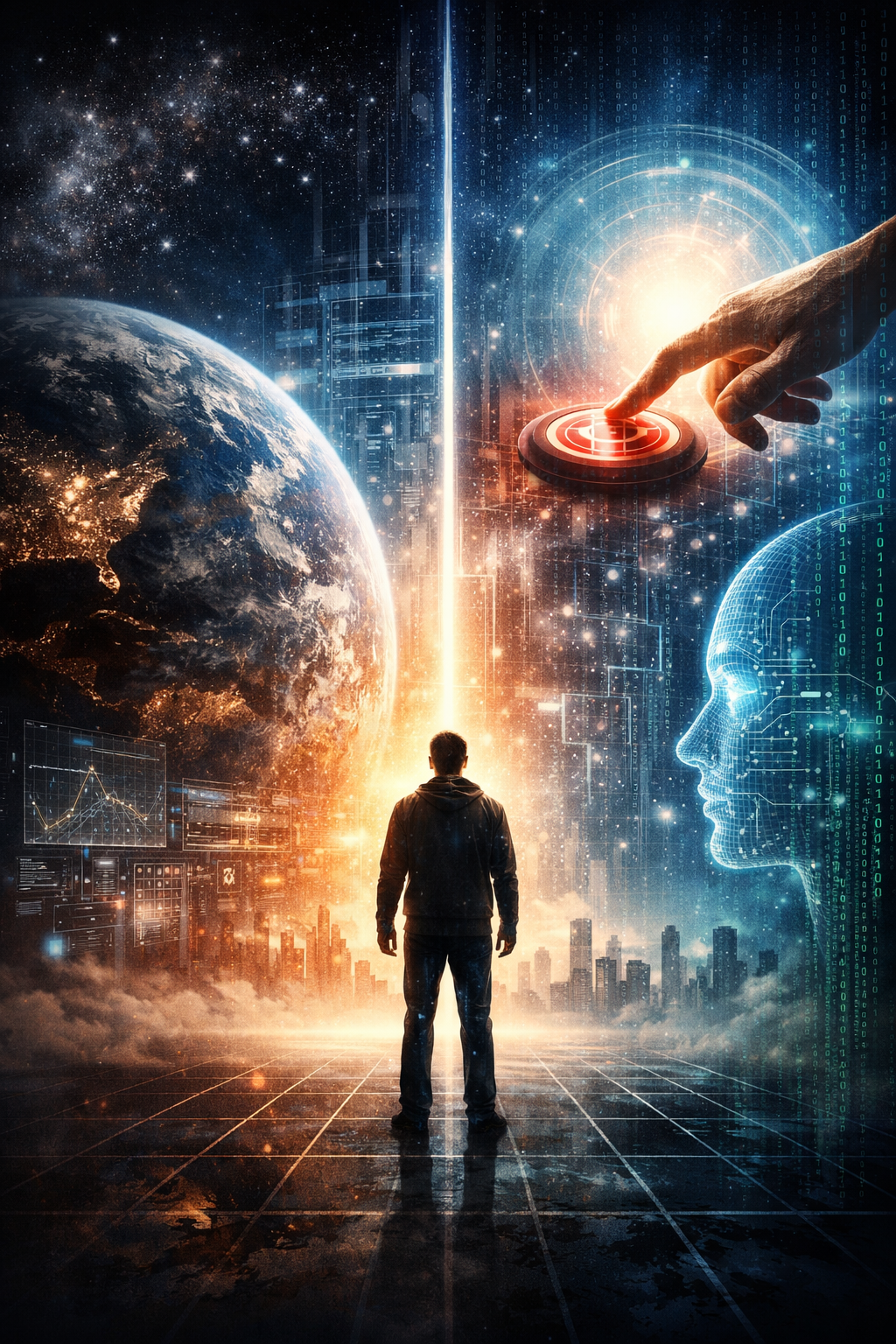
What if our universe is not “base reality,” but rather a constructed system—a kind of reset, restarted, or continuously running computational process? And more provocatively: what if human beings are not independent entities, but components within a larger simulation designed for purposes we do not fully understand?
While this may sound like science fiction, the idea has been taken seriously in both philosophy and science. It raises not only metaphysical questions, but also deeply practical ones:
- If we are in a simulation, can we ever exit it?
- Can we influence or control its flow?
- Can we improve our outcomes—health, wealth, longevity—within it?
This article explores these questions with intellectual honesty—balancing speculation with grounded reasoning.
1. Why the Simulation Hypothesis Is Taken Seriously
The notion that reality might be simulated is often referred to as the Simulation Hypothesis, most famously articulated by philosopher Nick Bostrom.
His argument, simplified, suggests that at least one of the following must be true:
- Advanced civilisations never reach the capability to simulate conscious beings
- They reach that capability but choose not to use it
- We are most likely already living inside such a simulation
This is not proof—it is a probabilistic argument. But it becomes more compelling when combined with certain observations from physics:
- The universe appears to have discrete limits (e.g., smallest measurable units of time and space)
- Reality behaves probabilistically at the quantum level
- Observation seems to play a role in determining physical outcomes
These features resemble aspects of computational systems: resolution limits, processing constraints, and conditional rendering.
2. Is Reality “Rendered” Like a Simulation?
In quantum mechanics, unobserved systems exist in a state of superposition—multiple possibilities at once—until measurement occurs.
This has led some to draw parallels with a concept from computer graphics: “rendering on demand.”
In a game engine:
- Objects outside the player’s view may not be fully processed
- Details are generated only when needed
Similarly, in physical reality:
- Certain properties appear undefined until measured
While this does not prove simulation, it opens the door to a provocative interpretation:
Reality may not be a fully pre-loaded environment, but a dynamically resolved process.
3. If This Is a Simulation, Why Would It Exist?
If we entertain the hypothesis, the next logical question is purpose.
Possible explanations include:
a. Experimental Simulation
A system designed to observe:
- Human behavior
- Cooperation vs conflict
- Ethical development under constraints
b. Evolutionary Testing
A model to explore:
- How intelligence emerges
- Under what conditions it survive or collapse
c. Risk Modelling
Simulations of:
- Climate collapse
- War scenarios
- Technological risks
d. Consciousness Research
An attempt to understand:
- Subjective experience
- Awareness
- Meaning-making
In all these scenarios, humans are not merely “characters,” but active data-generating agents.
4. Can We Exit the Simulation?
This is where speculation meets limitation.
If we are inside a simulation, we are:
- Defined by its rules
- Constrained by its architecture
- Dependent on its underlying system
A useful analogy:
A character inside a video game cannot unplug the computer.
Unless the system designers have deliberately created an exit mechanism, there is no known way for an internal entity to access the external layer.
Therefore, the most rational conclusion is:
Exiting the simulation is highly unlikely, and not a practical objective.
5. Can We Control or Influence the Simulation?
Here, the answer becomes more interesting.
We likely cannot control:
- The fundamental laws of physics
- Initial conditions (birthplace, genetics)
- Large-scale external events
However, we can influence:
- Decisions
- Habits
- Learning processes
- Social interactions
- Risk management
In other words:
We cannot control the system itself—but we can optimize our strategy within it.
This resembles a structured environment like a game:
- Rules are fixed
- Outcomes are probabilistic
- Skill still matters
6. Can We Shape Our Outcomes? (Health, Wealth, Longevity)
Even within constraints, outcomes are not fixed.
Health
Scientific evidence shows that:
- Sleep, nutrition, and physical activity
can significantly affect lifespan and quality of life.
Wealth
Economic systems tend to reward:
- Problem-solving
- Value creation
- Scalability
Wealth is not random—it is often the result of aligned strategy within system rules.
Longevity
While mortality cannot be eliminated, it can be influenced:
- Preventive care
- Stress management
- Behavioral discipline
These are not “cheat codes,” but they are high-level optimisations.
7. Interpretation: The Most Powerful Lever
Even if we cannot change the system, we can change how we interpret it.
Two individuals in identical conditions may experience completely different realities based on:
- Meaning attribution
- Perspective
- Psychological framing
This leads to a crucial insight:
The most accessible form of control is not physical—it is cognitive.
8. A Critical Warning
The simulation hypothesis can be misused.
If misunderstood, it may lead to:
- Nihilism (“Nothing matters”)
- Detachment from responsibility
- Ethical indifference
However, this is a flawed conclusion.
Even in a simulated environment:
- Pain is experienced
- Consequences are real within the system
- Actions affect other conscious agents
Therefore:
Meaning and responsibility remain valid—even if reality is simulated.
Conclusion: The Only Rational Position
We do not know whether we are in a simulation.
We may never know.
But we can say this with confidence:
- The hypothesis is philosophically and scientifically plausible
- It is currently unprovable and unfalsifiable
- It does not reduce the importance of how we live
The most rational response is not to seek escape, but to refine participation.
If this is a simulation, then mastery—not escape—is the meaningful objective.
And the final question becomes personal:
Are you merely existing within the system…
Or are you actively learning how to play it well?

Gürkan KAVRAZLI
Logistics Expert & Entegrator
Educator I Speaker I Author
About the Author
