Two railway visions reshaping logistics, geopolitics, and trade in the Middle East
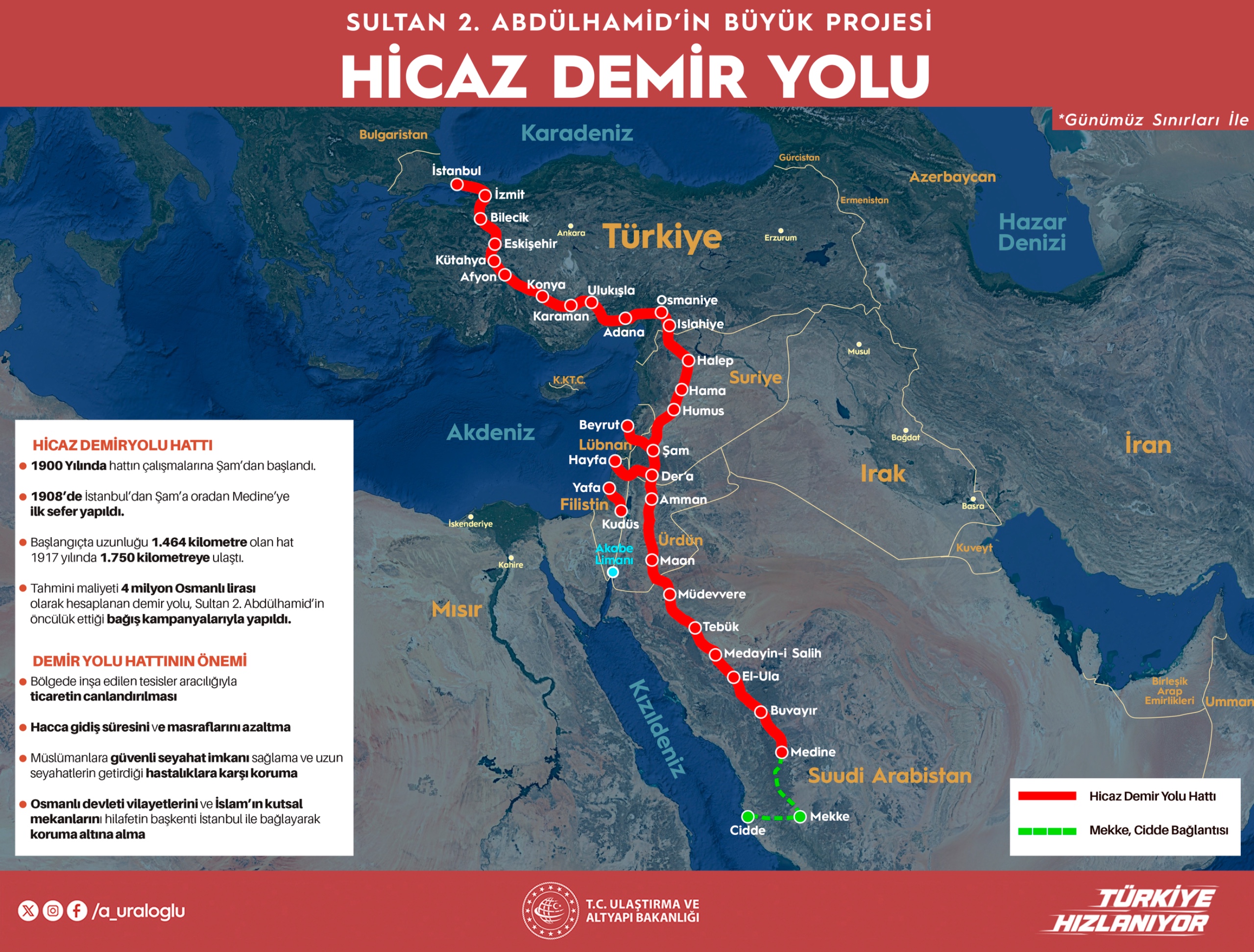
Global trade and logistics systems are undergoing a significant transformation due to rising geopolitical tensions, supply chain disruptions, and the risks of heavy reliance on maritime transportation. Recent disruptions in the Suez Canal and along the Red Sea route have intensified the search for alternative transport and trade corridors. Within this context, two major railway initiatives have gained prominence in the Middle East: the revival of the historic Hejaz Railway, a strategic infrastructure project of the Ottoman era, and the Red Sea–Mediterranean (Red–Med) land and rail corridor promoted by Israel.
This article aims to comparatively analyse these two projects from logistical, geopolitical, and economic perspectives. It examines their routes, the countries involved, their potential impact on global trade, and the advantages and challenges they may present for Turkey and the wider region. The findings show that the Hejaz Railway primarily supports regional integration and trade connectivity, while the Red Mediterranean Corridor has the potential to function as a global logistical alternative to the Suez Canal.
Keywords
Hejaz Railway, Red–Med Corridor, Middle East Logistics, Rail Transportation, Global Trade Routes, Geopolitics, Türkiye
INTRODUCTION
Global trade has entered a period of profound uncertainty. The COVID-19 pandemic, regional wars, geopolitical tensions, and repeated disruptions in supply chains have exposed the fragility of over-reliance on maritime routes. Incidents in the Suez Canal and rising security risks in the Red Sea have further intensified the search for alternative logistics corridors.
In this context, the Middle East has re-emerged as a strategic geography through two major railway initiatives:
- the revival of the historic Hejaz Railway, and
- The Red Sea–Mediterranean (Red–Med) land and rail corridor led by Israel.
Although both projects place rail transport at their core, their objectives, scale, and global impact differ significantly.
THE HEJAZ RAILWAY: A HISTORICAL ROUTE WITH MODERN AMBITIONS
Originally constructed during the Ottoman era, the Hejaz Railway connected Damascus to Medina, serving religious, administrative, and strategic purposes.
Today’s revival initiative goes far beyond heritage preservation. Discussions between Türkiye, Syria, and Jordan aim to modernise the line and re-establish rail connectivity between Türkiye and the Middle East.
Logistics Perspective
- Creates a rail alternative to long-haul road transport
- Reduces transportation costs and carbon emissions
- Provides access to the Red Sea via Aqaba Port
Winners and Challenges
Potential beneficiaries: Türkiye, Jordan, and regional Middle Eastern trade networks.
Key challenges: Political instability along the route, particularly in Syria, and limited relevance to global container shipping.
THE RED–MED CORRIDOR: A LAND BRIDGE FOR GLOBAL TRADE
The Red–Med project aims to connect Israel’s Eilat Port on the Red Sea with Mediterranean ports such as Ashdod, Tel Aviv, or Haifa via rail and road infrastructure.
Its strategic objective is clear: to create a land-based alternative to the Suez Canal, enabling faster and more resilient Asia–Europe trade flows.
Logistics Strengths
- Shorter transit times through sea-rail integration
- Strategic flexibility during maritime disruptions
- Appeal to Asian manufacturing and export hubs
Limitations
- High investment and operational costs
- Limited capacity at Eilat Port
- Sensitivity to regional political tensions
COMPARATIVE ASSESSMENT
| Aspect | Hejaz Railway | Red–Med Corridor |
|---|---|---|
| Primary focus | Regional integration | Global trade alternative |
| Direction | North–South | East–West |
| Strategic value | Regional stability | Suez diversification |
| Main risks | Political/security | Cost/geopolitics |
| Impact on Türkiye | Direct | Indirect |
STRATEGIC IMPLICATIONS FOR TÜRKIYE AND THE REGION
For Türkiye, the Hejaz Railway represents a strategic opportunity to:
- Strengthen economic ties with the Middle East
- Enhance its role as a regional logistics hub
- Shift freight transport from road to rail
The Red–Med Corridor, meanwhile, should be viewed as a competitive global route rather than a partnership-driven project.
CONCLUSION
The Hejaz Railway and the Red–Med Corridor reflect two distinct visions for the future of Middle Eastern logistics. One prioritises regional integration and resilience, while the other focuses on global trade efficiency and diversification.
Their success will depend on political stability, financing, security, and shifting global trade patterns. Yet one conclusion is undeniable:
The future of trade is once again being built on rails.
REFERENCES
Hejaz Railway — Britannica Encyclopedia https://www.britannica.com/topic/Hejaz-Railway?utm
Hejaz Railway – Wikipedia https://en.wikipedia.org/wiki/Hejaz_railway?utm
Hejaz Railway – UNESCO Dünya Mirası Merkezi https://whc.unesco.org/en/tentativelists/6026/?utm
Trans-Caspian International Transport Route (Middle Corridor)
Red Sea and Mediterranean Sea land bridge via Eilat
SY Lakhal ve Souad H’Mida tarafından yazılan akademik çalışma — Red-Med Railway Projesi’nin Suez Kanalı’na rakip olma potansiyeli ve lojistik/ekonomik değerlendirmesi
The Red-Med Railway: New Opportunities for China, Israel, and the Middle East — Bölgesel jeoekonomi ve lojistikte Red-Med projesinin rolünü ve Çin’in Kuşak ve Yol Girişimi (BRI) bağlamında olası katkılarını tartışan politika metni.
- Al-Salamah, Mohammed ibn Abdulrahman. Saudi Arabia’s Efforts to Revive the Hijaz Railway (1925–1982). Darah Journal of Arabian Peninsula Studies.
- Lakhal, S. Y. & H’Mida, S. (2017). The Red-Med railway project: A serious competitor to the Suez Canal? Independent Journal of Management & Production.
- Besacenter Perspectives: The Red-Med Railway: New Opportunities for China, Israel, and the Middle East.
Britannica – Hejaz Railway.
UNESCO World Heritage Centre – Hejaz Railway.
High-speed railway to Eilat – Wikipedia.
Gürkan KAVRAZLI
Logistics Expert & Entegrator
Educator I Speaker I Author
About the Author
